
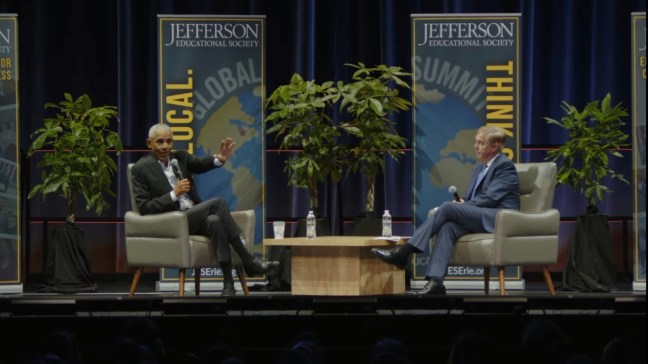
ERIE, Pa. – Former President Barack Obama discussed the aftermath of the Charlie Kirk assassination during a formal conversation on Tuesday, Sep. 16, at the Jefferson Educational Society in Pennsylvania.
The transcript.
“Well, we are certainly at an inflection point, not just around political violence, but there are a host of larger trends that we have to be concerned about. I think it is important for us, at the outset, to acknowledge that political violence is not new. It has happened at certain periods in our history, but it is something that it is anathema to what it means to be a democratic country.
And regardless of where you are on the political spectrum, what happened to Charlie Kirk was horrific and a tragedy. What happened, as you mentioned, to the state legislators in Minnesota, that is horrific. It is a tragedy.
And there are no ifs, ands or buts about it, the central premise of our democratic system is that we have to be able to disagree and have sometimes really contentious debates without resort to violence. And when it happens to some but even if you think they’re, quote, unquote, on the other side of the argument, that’s a threat to all of us. And we have to be clear and forthright in condemning them.
Now, that doesn’t mean that we can’t have a debate about the ideas that people who were victims of political violence were promoting. And so, I’ve noticed that there’s been some confusion, I think, around this lately, and frankly, coming from the White House and some of the other positions of authority that suggest, even before we had determined who the perpetrator of this evil act was, that somehow we’re going to identify an enemy. We’re going to suggest that somehow that enemy was at fault, and we are then going to use that as a rationale for trying to silence discussion around who we are as a country and what direction we should go. And that’s a mistake as well.
And so, look, obviously I didn’t know Charlie Kirk. I was generally aware of some of his ideas. I think those ideas were wrong, but that doesn’t negate the fact that what happened was a tragedy and that I mourn for him and his family.
He’s a young man with two small children and a wife who obviously — and a huge number of friends and supporters who cared about him. And so, we have to extend grace to people during their period of mourning and shock.
We can also, at the same time, say that I disagree with the idea that the Civil Rights Act of 1964 was a mistake. That’s not me politicizing the issue. It’s making an observation about who are we as a country. I can say that I disagree with the suggestion that my wife or Justice Jackson does not have adequate brain processing power. I can say that I disagree that Martin Luther King was awful. I can disagree with some of the broader suggestions that liberals and Democrats are promoting conspiracy to displace whites and replace them by ushering in illegal immigrants.
Those are all topics that we have to be able to discuss honestly and forthrightly, while we still insist that in that process of debate, we respect other people’s right to say things that we profoundly disagree with. That’s how we should approach this.
Now, the last point I’ll make on this or building on a point I made earlier, I’ve been very impressed with Governor Cox in Utah and how he’s approached some of these issues. I suspect Governor Cox and I disagree on a whole bunch of stuff. He is a Republican, self-professed conservative Republican, but in his response to this tragedy, as well as his history of how he engages with people who are political adversaries, he has shown, I think, that it is possible for us to disagree while abiding by a basic code of how we should engage in public debate.
I think your own governor here, Josh Shapiro, has done the same thing. When I was president in the aftermath of tragedies, when Dylann Roof went into a Black church and based on his own words, shot a group of folks who were engaged in bible study and who had invited him in, and according to him, it was for racist reasons, as President of the United States, my response was not, who may have influenced this troubled young man to engage in that kind of violence, and now let me go after my political opponents and use that.
George Bush, again, I don’t agree with him on a lot of stuff, but he is a good, gracious man. And one of the, I thought, most commendable things that he did after 9/11, the most horrific thing to happen to the United States during the course of my lifetime, in my memory, in the aftermath of this terrible tragedy, made a point, “We are going to go after the people who perpetrated this.” But he explicitly went out of his way to say, “We are not at war against Islam,” and systematically and repeatedly talked about how we can’t use this as a way to divide and target fellow Americans.
And so, when I hear not just our current president, but his aides, who have a history of calling political opponents ‘vermin’, enemies who need to be ‘targeted,’ that speaks to a broader problem that we have right now and something that we’re going to have to grapple with, all of us.
Whether we’re Democrats, Republicans, Independents, we have to recognize that on both sides, undoubtedly, there are people who are extremists and who say things that are contrary to what I believe are America’s core values.
But I will say that those extreme views were not in my White House. I wasn’t embracing them. I wasn’t empowering them. I wasn’t putting the weight of the United States government behind extremist views. And that…when we have the weight of the United States government behind extremist views, we’ve got a problem.
And so, then your original question is, are we at an inflection point? (Laughter.) We’re at an inflection point in the sense that we always have to fight for our democracy, and we have to fight for those values that have made this country the envy of the world. And I often say democracy is not self-executing. It depends on us as citizens, regardless of our political affiliations, to stand up for certain core values, because otherwise we may not have them.”
– Former President Barack Obama
View the full conversation here.
- New charges filed against two men involved in deadly Clinton shooting

- Second arrest made in Rock Island County child porn, sex abuse investigation

- Suspect granted pretrial release on battery charges despite violations before allegedly killing victim

- ‘Heart of gold’: Clinton man who recently became father identified as victim in deadly shooting

- Another continuance granted in Jackson Kradle homicide case against former deputy

- Bureau County grand jury indicts four men accused of stealing man’s vehicle at knifepoint

- Newsletter: February 16, 2026

- Davenport man returns to jail after police receive new allegations of child sex abuse

- Police: One student arrested after fight at Rock Island High School Wednesday

- Pretrial release revoked for Davenport man charged with attempted murder in hit and run crash

Discover more from KJB REPORTS
Subscribe to get the latest posts sent to your email.
